Every week we open a CV that worked in Lagos, Lahore, Manila, Kyiv or São Paulo and would not get past the first screen in Mississauga. The experience in it is often better than the Canadian competition’s. The document is the problem: a photo, a date of birth, five pages, a “Curriculum Vitae” heading, a declaration at the bottom, and job titles that mean something different here. None of that is a mistake where the CV was written. All of it is a signal here, and the signal is “written for somewhere else”.
This guide is the Canadian resume format, section by section, for someone arriving with an international CV: what a Canadian-style resume looks like, why the resume format employers in Canada expect differs from the one that worked at home, a full example, and a free Word template to start from. It is written from the conversions we do for newcomers across Canada, and the official guidance it leans on is Job Bank, the federal government’s job site.
- Two pages, reverse chronological, one column, standard headings, saved as a PDF.
- No photo and no personal details: no date of birth, marital status, nationality, ID numbers or SIN.
- A Canadian header: city and province, a Canadian phone number, email, LinkedIn, one line on work authorization, and the title the employer is hiring for.
- A short profile instead of an objective, then experience written as results with numbers, with a scope line under every employer.
- Your degree with its Canadian equivalency from a designated assessment service (WES, ICAS, IQAS, ICES or CES) and your registration status in the regulator’s words.
- No objective, declaration, signature or references on the page. References go on a separate sheet, provided when asked.
The Format
What “Canadian format” means, and why employers notice when it is missing
Nine conventions that recruiters and hiring managers here have read thousands of times.
There is no law that defines a Canadian resume. There is a set of conventions, and a resume that follows them is read for what it says. A resume that does not is read for what it is: foreign, and therefore work. A recruiter with ninety applications open does not translate titles, look up employers or wonder which of the five pages matters. They move on.
Job Bank tells job seekers to limit a resume to two pages and to cut or minimize roles more than fifteen years old.
No photo, age, date of birth, marital status, religion, nationality, passport or ID number, and never a Social Insurance Number.
Most recent role first, dates as month and year. A functional resume that hides the dates reads as a warning sign.
City and province, a Canadian phone number and a LinkedIn URL. A foreign number at the top of the page is the fastest way to be skipped.
Under your name, in the posting’s words, with a three- or four-line profile instead of an objective statement.
Every role states the size of the employer and the team before it states what you changed, then results with numbers.
Each degree with its full name, institution, country and year, and the one line that places it: its Canadian equivalency from WES or another designated assessment service.
An ATS-friendly layout: one column, standard headings and the posting’s own words, saved as a PDF with a Word copy for portals that ask.
No “I hereby declare” line, no signature, no hobbies, no salary history. References go on a separate sheet, provided when asked.
A resume also has to survive software before it reaches a person. Most larger Canadian employers screen applications with an applicant tracking system (ATS), and the layouts that international CVs favour, two columns, a header table, icons, a footer of personal data, are exactly what those systems parse worst. One column and standard headings are not a style preference; they are the difference between the resume arriving intact and arriving as a jumble. The same format applies whether you are an international student, a nurse, a caregiver, a tradesperson or a software developer: the headings and their order do not change, only the weight each section carries. The page itself is Letter size, 8.5 by 11 inches, the North American standard: a CV set up on A4 prints wrong here and reads as foreign before a word of it is read. Margins of about an inch, one standard font at 10.5 to 12 points, and nothing in the header or footer of the file, which some systems skip.
What changes from an international CV, at a glance
| What | International CV | Canadian resume |
|---|---|---|
| Length | Three to five pages, every role in full | Two pages, with the weight on the last ten to fifteen years |
| Heading | “Curriculum Vitae” at the top | Your name, and nothing else on that line |
| Personal details | A photo, date of birth, marital status, nationality, an ID number | None of them: city and province, a Canadian phone number, email, LinkedIn |
| Opening | An objective statement | The target title in the posting’s words and a three- or four-line profile |
| Work status | Immigration history, or nothing | One line on work authorization, in the words that apply to you |
| Experience | Duties copied from the job description | A scope line, then results with numbers; your real title with its Canadian equivalent |
| Dates | Years only, or 01/2019 | Month and year, written out, most recent first |
| Education | The degree and the grade, in local terms | Full name, institution, country, year, and the Canadian equivalency; registration status in the regulator’s words |
| Skills | Adjectives: hard-working, team player | Tools, systems, standards and methods in the posting’s words; languages with levels |
| Closing | References, a declaration, a signature and date | Nothing; a separate reference sheet when asked |
| Layout and file | Two columns, tables, icons, on A4 | One column, standard headings, Letter size, a PDF with a Word copy |
Anatomy
The anatomy of a Canadian-format resume
Four zones, in this order, on two pages. Tap or hover a callout to see it on the page.
- 01
The header and profile
Name, city and province, a Canadian phone number and a LinkedIn URL, then the title the employer is hiring for, one line on work authorization and a three- or four-line profile. No photo, no date of birth, no ID numbers.
- 02
The credentials line
Your degree with its Canadian equivalency from a designated assessment service (WES, ICAS, IQAS, ICES or CES) and your registration status, stated exactly, in the top third of page one where a recruiter looks for it.
- 03
The experience
Each role opens with a scope line, employer size, sector and country, then results with numbers, most recent first, with your real title and its Canadian equivalent in brackets.
- 04
The Canadian lines
Education, skills in the posting’s words, languages with levels, and the certifications and memberships earned since arriving: WHMIS, First Aid, a bridging program, a professional association.
The sections, in order
Standard heading names, in the order the example uses them. Rebuild your CV in this order and nothing from the old one survives by accident.
- Headeryour name, the target title in the posting’s words, city and province, a Canadian phone number, email and LinkedIn.
- Work authorizationone line, if you need it.
- Professional profilethree or four lines; some resumes call it Summary.
- Experiencemost recent first, each role with a scope line and results; older roles in one line each under Earlier experience; a survival job in one line under Additional experience.
- Education and credentialseach degree with its equivalency, and registration status where it applies.
- Skillssystems, standards and methods in the posting’s words, and languages with levels.
- Canadian certifications and membershipsWHMIS, First Aid, a bridging program, a professional association, each with the issuing body and the date.
Volunteer work goes under Additional experience, or under its own heading when it is substantial. Three situations change the order, or the weight each section carries.
- 1A new graduate or international studentOne page is usually enough. Education moves above Experience, with the Canadian program first if you studied here, and co-op terms, internships, capstone projects and part-time work are written as experience, each with a scope line and a result. The authorization line carries the permit: “Post-graduation work permit, valid to [month, year]”.
- 2A skilled trades workerCertifications move up, directly under the profile: your trade certification or Red Seal status stated as it stands (registered apprentice, challenge exam booked, certified), then the safety tickets Canadian sites ask for, WHMIS, Working at Heights, forklift, each with the issuing body and the date. Equipment, codes and standards go in the skills block, and the bullets carry throughput, downtime and the safety record.
- 3A regulated professionThe registration status line goes directly under the profile, in the regulator’s own words, and never a licence claimed while it is in progress. The assessment you name is the one the regulator requires, which is not always the general WES report. The worked lines for nurses, engineers, accountants, physicians, teachers and pharmacists are in the credentials guide.
Length
The two-page rule and what to cut
Job Bank’s rule, and how to apply it to a twenty-year career.
Limit your resume to two pages, and cut or minimize jobs and experience more than fifteen years old.
Job Bank, How to write a good resume (Government of Canada)
For most newcomers with a long career that means a decision about weight, not a decision about honesty. The last ten to fifteen years get space in proportion to their relevance to the posting. Older roles become one line each under a heading such as Earlier Experience, with the employer, the title and the years, and nothing else. A role from 2004 does not get the same four bullets as the role you held last year. If you are worried about the phrase “Canadian experience”, that question has its own guide.
What goes first is what the posting cares about. If the job is a senior accountant role and your last two years were spent in a survival job, the accounting career leads and the survival job gets one line later on the page. If you ran a department of forty people and the posting is for a coordinator, the resume says so without apology, in the scope line, and then shows the hands-on work the coordinator role needs.
The Header
The header: Canadian contact details and one line on work authorization
The first thing a reader sees, and the first place an international CV gives itself away. It needs five things and one optional line.
Chinwe Okafor1
Senior Accountant · Financial Reporting & IFRS2
Mississauga, ON3
(647) 555-01994
chinwe.okafor@email.com
linkedin.com/in/chinweokafor5
Permanent resident, eligible to work for any employer in Canada.6
- 1Your name, as you use it professionally, and nothing else on that line: no “Curriculum Vitae”, no “Resume of”, no photo beside it.
- 2The target title: the title the employer is hiring for, in their words, with the specialism the posting names after it if you have one. “Senior Accountant”, not “Accounting professional seeking opportunities”. It changes with every posting, and it is the first keyword the software looks for.
- 3City and province, not a street address. If you have not landed yet, write “Relocating to Mississauga, ON, March 2027” and let the cover letter carry the detail.
- 4A Canadian phone number. A foreign country code at the top of the page is the fastest way to be skipped, because the reader assumes a time zone problem first. A Canadian number can be set up before you arrive.
- 5A plain email address and your LinkedIn URL, customized so that it reads as your name.
- 6One line on work authorization, in the words that apply to you: “Permanent resident, eligible to work for any employer in Canada” or “Open work permit, valid to [month, year]”. No explanation and no immigration history. If you are a citizen, you do not need the line.
The Profile
Target title and profile
Three or four lines a recruiter can repeat to a hiring manager.
The profile replaces the objective statement, which Canadian resumes stopped using years ago. An objective says what you want. A profile says what you are: your profession, your years, the scale you worked at, the specialism the posting asks for, and the one credential line that places you here.
Professional profile
Senior Accountant with nine years in statutory reporting and audit for listed companies in Nigeria and the UAE, including IFRS consolidation for a group with twelve subsidiaries. Bachelor of Commerce assessed by WES as equivalent to a Canadian bachelor’s degree; CPA Ontario student, prerequisite courses in progress.
Profession, years, scale, specialism, credential line. Every highlighted phrase is something the reader can check against the posting.
Notice what it does not say: nothing about being hard-working, passionate or a team player, nothing about seeking a challenging opportunity, nothing about your reasons for moving.
Experience
Experience: the scope line, results with numbers, Canadian titles
This is where an international resume most often loses the reader, and the fix is a single habit: context before results.
Experience
Deputy Manager (Operations Manager)3 · [Company]January 2019 to March 20244
Lagos, Nigeria · A 1,500-employee food and beverage manufacturer; ran a 40-person packaging line.1
- Raised line output 31% in two years and cut recordable safety incidents to zero.2
- Brought waste below 2% of output against a 4% plant target by retraining 40 operators on new line procedures.
One entry, written the Canadian way. The four numbered habits are below.
- 1The scope lineUnder each employer, before the bullets, one line that tells the reader what the organization is, in terms a Canadian can weigh: its size, its sector and its country. “A 300-person pharmaceutical manufacturer supplying hospitals across Gujarat.” For an employer nobody here has heard of, that line is the whole introduction, and without it the role underneath reads as ordinary no matter what you achieved.
- 2Results with numbersCanadian employers hire on outcomes they can place: revenue, savings, headcount managed, throughput, error rates, deadlines met, audits passed. “Responsible for production operations” becomes “Raised line output 31% in two years”. Where currency matters, convert it and say so: “revenue of about CAD 4 million”. Where the number is not yours alone, say what your part was.
- 3Your real title, with the Canadian equivalentTitles do not travel. An “Executive” in South Asian corporate English is often a junior role; a “Deputy Manager” can be the person who ran the whole site; an “Officer” can be anything. “Deputy Manager (Operations Manager)” tells the reader what you did without claiming a title you did not hold.
- 4Dates as month and year, written out“January 2019 to March 2024”, not “01/2019 to 03/2024”, and never a functional resume that hides the dates to disguise the move. Canadian recruiters read dates first, and a resume that makes them hunt for the dates reads as a warning sign even when the only gap is a flight.
Each role gets three to six bullets in the last ten years and fewer before that, each bullet one line or two, each beginning with a verb and ending with a result where there is one.
Credentials
Education and credentials: the one line that places a foreign degree
A foreign degree is not a problem on a Canadian resume. A foreign degree with no frame around it is, because the reader guesses what it is worth, and they guess low.
Education and credentials
Bachelor of Commerce, [University], Lagos, Nigeria, 2015 · assessed by WES as equivalent to a Canadian bachelor’s degree, 2026
CPA Ontario student member, 2026; prerequisite courses in progress
The degree with its full name, institution, city, country and year, the line that places it, then the registration status in the regulator’s words.
The assessment services employers recognize are the ones Immigration, Refugees and Citizenship Canada designates: World Education Services, ICAS of Canada, IQAS, ICES and the University of Toronto’s Comparative Education Service, with separate professional bodies for physicians, pharmacists and architects. If the assessment is in progress, say so with the expected date.
If you are in a regulated profession, your registration status goes here or under its own heading, in the regulator’s own words, and never as a licence held when it is in progress. That one line is where a nurse, an engineer, an accountant, a physician, a teacher or a pharmacist is either placed correctly or quietly filtered out, and it deserves its own guide.
Skills
Skills, languages, certifications
What the software searches for, and the lines that tell the reader you have started here.
Things a posting names and software searches for: the tools, systems, standards and methods of your field, in the spelling the posting uses. Not “communication” and “teamwork”, which say nothing and take space. Group them if there are many.
Their own line, listed, because employers in every sector value them and because a recruiter searching for a Punjabi-speaking customer service lead or a Portuguese-speaking project coordinator searches for the word. State your level for each.
With the issuing body and the date. WHMIS, the workplace hazardous materials training most employers ask for, is usually the first; the Canadian ones you have earned since arriving are worth their line even when they are small, because each one tells the reader you have started here.
Example
A full Canadian resume format example
The sections above, assembled into one resume and shown as the two pages of its PDF, so it looks the same on every screen. Two pages, as a Canadian resume should be; the details are illustrative.
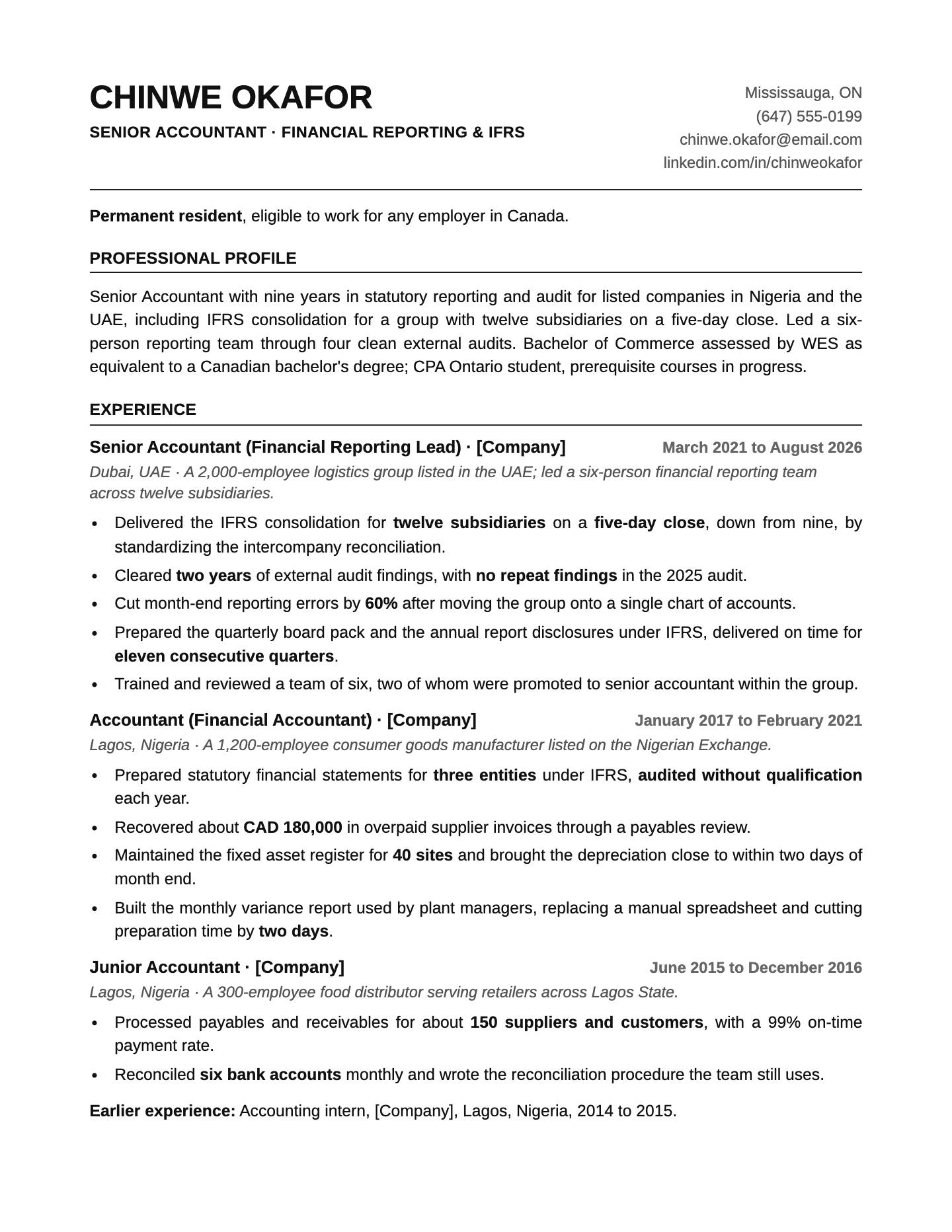
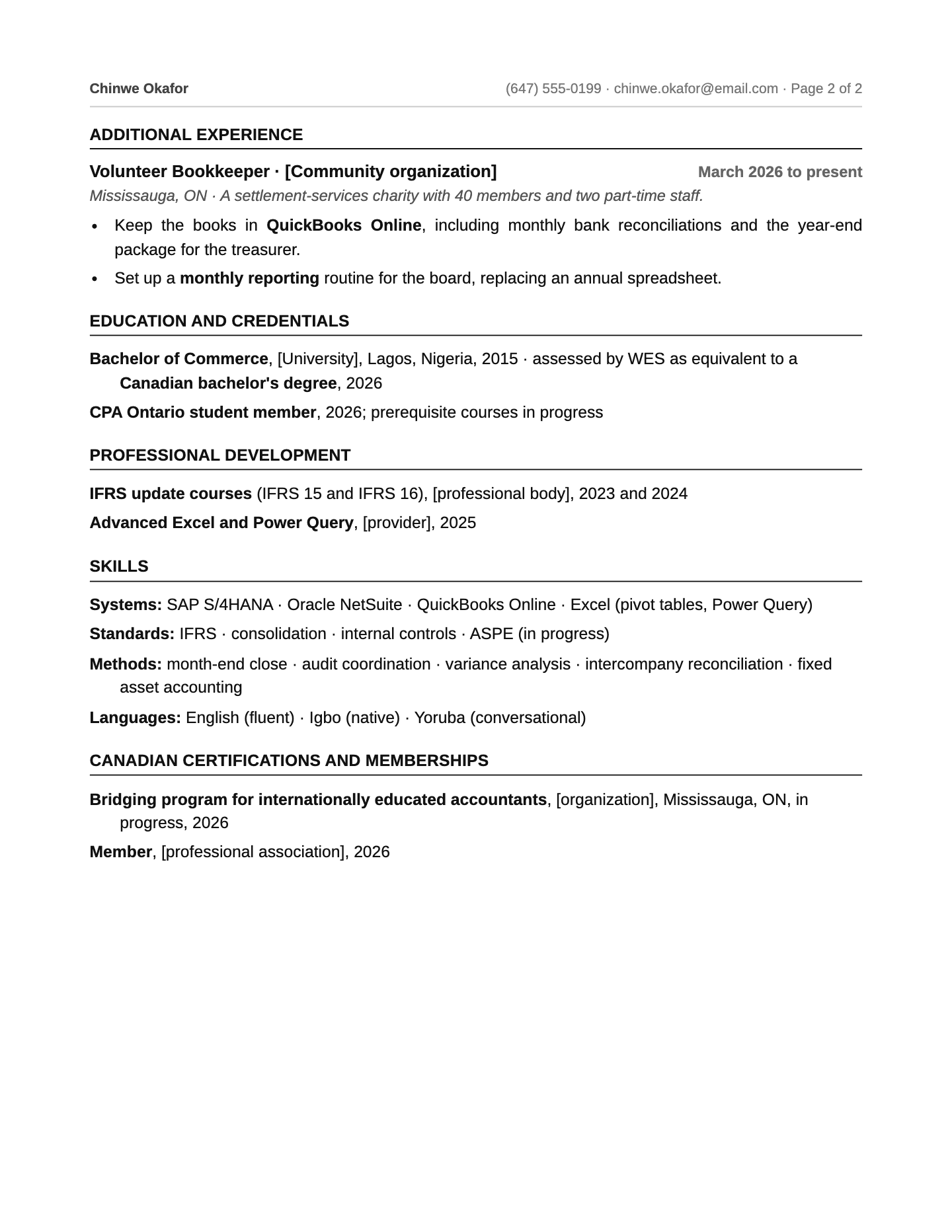
Want the format as a file? The example above is a free two-page PDF, and the same layout with a placeholder for every line is a free Word template: one column, standard headings, ATS-friendly. Fill the template in from the example, save it as a PDF, and keep the Word copy for portals that ask for one.
Leave It Off
What never goes on a Canadian resume
Job Bank’s list, and ours, is the same. Canadian employers are limited in what they can ask about, and many will set aside a resume that volunteers those details rather than handle them.
- A photo (Job Bank says it can actually lower your chances)
- Age or date of birth
- Marital status, number of children
- Religion, nationality, place of birth
- Passport, national ID or Social Insurance Number
- An objective statement
- “Curriculum Vitae” or “Resume” as a heading
- A declaration, a signature, a date
- Hobbies, unless the posting makes them relevant
- Salary history or expected salary
- References on the page
- City and province, a Canadian phone number, email, LinkedIn
- One line on work authorization, if you need one
- The target title, in the posting’s words
- A three- or four-line profile in place of the objective
- Your degree with its Canadian equivalency, and registration status in the regulator’s words
- A separate reference sheet, ready when asked: each referee’s title, relationship to you, email, phone with country code and time zone
Job Bank’s guidance on references is that an employer only needs them when they are seriously considering hiring you, which is why they belong on a separate sheet rather than on the resume.
Before & After
Before and after, section by section
Six changes of the kind we make every week, with illustrative details rather than any one client’s. They cover different professions from the examples on our newcomer service page; the pattern is the same.
Curriculum Vitae. Date of birth: 3 March 1990. Civil status: married. Religion: Roman Catholic. Photo attached. +63 mobile number.
Name, Brampton, ON, Canadian phone, email, LinkedIn. One line: permanent resident, eligible to work for any employer in Canada. Target title: Elementary Teacher (Ontario College of Teachers application in progress).
Objective: To obtain a challenging position in a reputed organization where I can apply my knowledge and grow professionally.
IT Project Manager with eleven years delivering ERP and e-commerce projects for a Brazilian retail group with 90,000 employees, including a CAD 12 million ERP migration delivered on schedule. PMP certified. Bachelor of Computer Science assessed by WES as equivalent to a Canadian bachelor’s degree.
HR Executive, [Company], Pune. Handled recruitment, payroll and employee engagement activities.
HR Executive (HR Generalist), [Company], Pune, India, a 1,200-employee automotive components manufacturer. Ran recruitment for a 180-person engineering division, cut time-to-hire from 61 to 38 days and moved payroll for 1,200 staff onto a new system with zero missed pay runs.
B.Pharm, 2014, Very Good with Honours.
Bachelor of Pharmacy, [University], Cairo, Egypt, 2014. Document Evaluation completed by the Pharmacy Examining Board of Canada; Pharmacist Qualifying Examination Part I scheduled for [month, year]. Not yet registered with the Ontario College of Pharmacists.
Skills: hard-working, responsible, stress-resistant, communication, teamwork, MS Office.
Systems: SAP WM, Manhattan WMS, Excel (pivot tables, lookups). Standards: WHMIS 2015 (certified 2026), Transport of Dangerous Goods awareness. Operations: cross-dock scheduling, cycle counting, carrier management, KPI reporting. Languages: Ukrainian (native), Russian (fluent), English (professional).
References: Mr. A. Khan, Managing Director, +92 300 000 0000. I hereby declare that the above information is true to the best of my knowledge. Signature and date.
Nothing. The page ends with the last certification. A separate reference sheet is ready for the interview stage, with each referee’s email and time zone.
Want It Done For You?
Prefer a certified writer to make these changes to your CV?
Send it in for a free review and we will tell you what we would change first, no charge and no obligation.
Checklist
The checklist
Run your resume against these 21 points before you send it. Tick each line as you check it.
Every line is a yes or a no.
0 of 21 checked
Length and what to leave off
The header
Profile and experience
Education, skills and Canadian lines
Format and file
Want it on paper? The same 21 points fit on one page, free to print or share with a settlement agency, a library or a friend who is arriving.
FAQ
Frequently asked questions
Short answers to the questions we hear most.
What is the best resume format for Canada?
Reverse chronological, which is what Canadian employers and applicant tracking systems expect: your most recent role first, dates as month and year, one column, standard headings, two pages. The two to avoid are the functional format that hides the dates and the two-column designs that scramble in screening software. The sections above take each part in turn.
What is a Canadian-style resume?
Two pages, reverse chronological, one column with standard headings, no photo and no personal details. A Canadian header with city and province, a Canadian phone number and LinkedIn, one line on work authorization, the target title in the posting’s words, a short profile instead of an objective, results with numbers under each role, and your degree with its Canadian equivalency. The sections above cover each part and the full example shows them together.
Should I include a photo on my resume in Canada?
No. Job Bank says a photo is not the norm in Canada and can actually lower your chances of obtaining a position. The same goes for your date of birth, age, marital status, religion, nationality and any identity number. Use the space for results.
How long should a Canadian resume be?
Two pages, per Job Bank’s guidance, with experience more than fifteen years old cut or minimized. A new graduate’s resume is often one page. A senior professional’s is still two; a longer career means more selection, not more pages.
Resume or CV: which one do Canadian employers want?
A resume, for almost every job. In Canada “CV” usually means the long academic document used for university, research and some medical applications. If a posting asks for a CV in a business context, it means a resume. Our CV writing service covers the academic and medical kind.
Should I use a functional resume to hide the gap?
No. Canadian recruiters read dates first, and a functional format that hides them reads as a warning sign. The move is not a gap to hide; a one-line entry such as “Relocated to Canada, [month, year]; credential assessment and WHMIS completed” explains it and moves on.
Is there a free Canadian resume template I can download?
Yes. The Word template on this page follows the format exactly: one column, standard headings, a placeholder for every line a Canadian employer expects, and nothing an applicant tracking system misreads. Fill it in from the example above, save it as a PDF, and keep the Word copy for the portals that ask for one.
PDF or Word?
PDF, on Letter-size pages, named with your name and the role, unless the application portal says otherwise. Keep a Word copy for the portals that ask for one, and make sure both are one column with standard headings so the applicant tracking system reads them the same way.
Do I need Canadian spelling?
Yes, in the spelling the posting uses. Canadian English generally uses colour, centre, licence (the noun), organization and program. Match the posting where it differs.
Do I need a cover letter?
When the posting asks for one, always, and usually when it does not: it is where you pre-empt the questions a newcomer’s resume raises, in a sentence each. Our cover letter writing service page shows what a letter written to a posting looks like.
Should I mention my immigration status on my resume?
Only as one plain line on work authorization, in the words that apply to you: “Permanent resident, eligible to work for any employer in Canada” or “Open work permit, valid to [month, year]”. It answers the question a recruiter would otherwise have to ask. Leave out the immigration history, the category you came under and anything about your application. If you are a citizen, you do not need the line at all.
Is the resume format different in Quebec?
The structure is the same. The differences are the word and the language: in Quebec the document is usually called a CV, and most employers work in French and expect it in French, so newcomers heading for Montreal or Quebec City usually keep two versions, one in each language. The Government of Quebec publishes its own résumé guidance, with templates.

About the Author
Written by Khaqan Chaudhry
Khaqan Chaudhry is the founder and lead resume strategist of Elite Resume Writer, a Mississauga studio of certified resume writers serving clients across Canada. He has sat on the hiring side of the desk and writes about what gets a resume read. The conversions described in this guide are the ones the team does every week for newcomers to Canada.
Keep Reading
The other two newcomer guides, and the service behind them
Each guide covers one question in the depth it needs; the service page is where a certified writer takes it from here.
What “Canadian experience” really means to a recruiter, what Ontario’s 2026 posting rule changed, and what to put on a resume instead, line by line.
How to list a foreign degree, a WES or other ECA, and licensing status on a Canadian resume, with worked lines for nurses, engineers, CPAs and doctors.
A certified writer converts your international CV to the Canadian format, from the header to the credential line, starting with a free review of what you have now.
Sources: Job Bank, How to write a good resume; Immigration, Refugees and Citizenship Canada, Educational credential assessment: designated organizations and professional bodies; Gouvernement du Québec, Writing your résumé.
Ready for a Resume That Gets You the Interview?
Everything above is what our certified writers do. Packages start at $99, and the first draft arrives in two to three business days.
🛡️ 60-Day Interview Guarantee • Full Refund and Free Rewrite • Written by Real Expert Writers
Prefer to talk it through first? Book a free 15-minute call with the writer.